
Can I Help?
Understanding Legal Permission to Help Medically

Disclaimer: No one at Zero 5 Safety Training is a lawyer, and nothing in this article should be taken as definitive legal advice. It is strongly recommended that you review the Good Samaritan laws in your state.
I’ve taught CPR, AED, and first aid to the public for 11 years and one of the most common questions I get from students is, “will I get in trouble if ‘X’ happens?” In today’s litigious-focused society the reasonable desire to help out has been overshadowed by a fear of getting sued for you-name-it. This is extremely unfortunate because we have gone from being a society in which it was common courtesy to be quick to help a person in need (medically, flat tire on the side of the road, etc.) to one in which we are quicker to pull out our phones to videotape for social media and not help at all. In church safety ministry one of the best services we can do, and probably THE most likely skills to be applied, are medical aid. But there’s still the underlying concern of “what if”.
Understanding Good Samaritan Laws (Definitions)
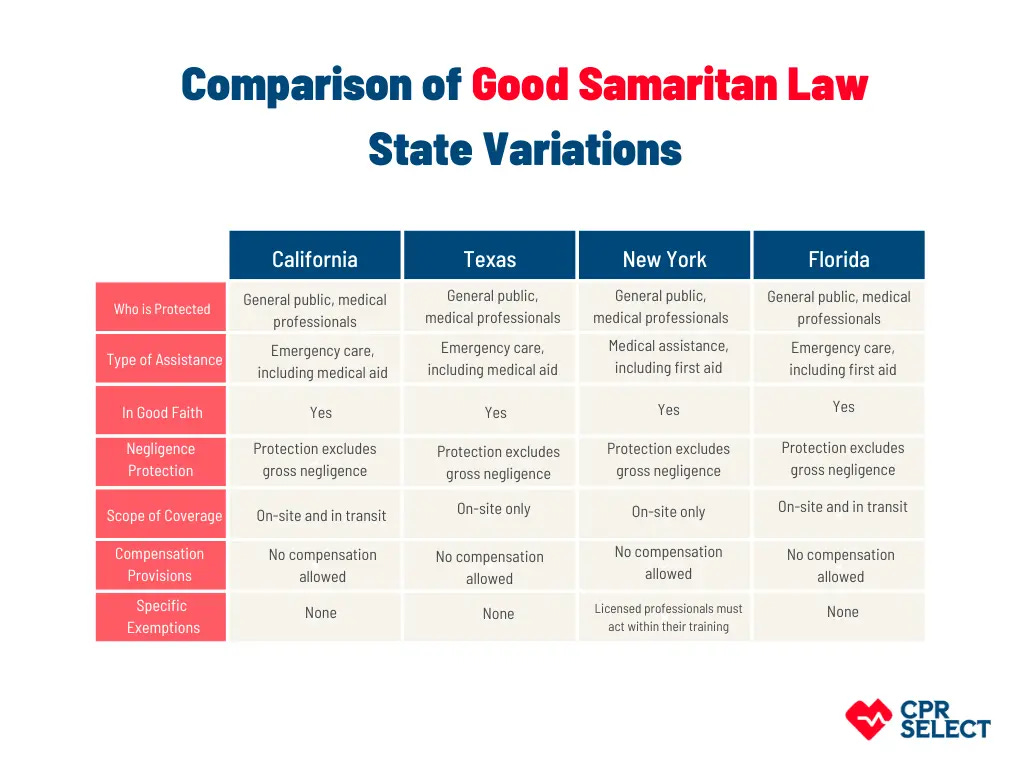
Most states have some version of a Good Samaritan law. Some are very broad and some are very concise in what actions are and are not protected. The purpose of Good Samaritan laws is to provide legal protection or defensibility to citizens who help out in various situations. In order to understand the Good Samaritan laws in your state it’s important to have a good understanding of a couple key terms:
Emergency
A sudden, unexpected situation involving imminent danger of death, serious injury, or harm that necessitates immediate action as would be defined as urgent by a reasonable person.
Voluntary/Gratuitous Act
Any act that is provided freely without legal obligation or expectation of compensation or award.
Duty to Act
Duty to act may be defined differently in each state. Typically it is reserved for specifically trained people or professionals who’s jobs entail them acting in the given situation. It can also be used for people who have others under their direct care. For instance, in Texas as an EMT I have a “duty to act” if I come upon a person suffering a medical emergency. It would be considered “abandonment” if I just passed that person and did nothing. Likewise, if a day care teacher has a child that is choking and they have received training on how to deal with choking (as required by state law), then that teacher has a duty to act; utilizing the training they have received to attempt to rescue the child from choking.
Negligence (Gross vs. Ordinary)
Failure to exercise a level of care that a reasonably prudent person would under similar circumstances. Some states label this as “failure to act”. Most Good Samaritan laws protect against “ordinary negligence” in which a person attempts to act, even though they may not exactly know what they are doing. “Gross negligence” is when a person DOES know what they are doing, or SHOULD know what they are doing and still fails to do it reasonably. For instance, if Johnny Q. Public took a first aid class 10 years ago, sees someone choking, attempts the Heimlich maneuver improperly, and the person dies; Johnny Q. Public technically committed ordinary negligence because he didn’t perform the maneuver properly, but is generally protected because he at least acted in a manner to help. Conversely, if I as a current EMT do the exact same thing I would be found grossly negligent in court.
Consent (Actual vs Implied)
Direct permission by the victim or patient to act accordingly. Actual consent is me asking the choking person if I can help and them nodding “yes”. Implied consent is them looking at me with panic and shock in their eyes and me determining that they’re ok with me helping them. Another example of this implied consent; back when I was stationed in California you were required to ask the “dead” person if they were ok with you performing CPR. Their unconsciousness was considered implied consent.
Good Samaritan Law Application
For church safety ministries Good Samaritan laws allow us to help our congregation with medical emergencies up to the level allowed by the law. That is why understanding these laws is SO important. In the remainder of this article I’m going to use Texas as an example for ways that my church safety ministry applies these protections.
Texas has very broad protections under its Good Samaritan Law. It basically allows anyone to help another person, regardless of the level of their training, according to what they or a reasonable person would deem necessary and responsible under the given circumstances. What that basically boils down to is that unless your position/job specifically requires CPR/AED/First Aid certifications by state law you are not required to have those certifications to assist in an emergency. The caveat to that coverage is that it is not a blanket coverage against lawsuit, only defensibility; meaning, you can still get sued but your defense is pretty well set provided you can verbalize the reasoning behind your actions.
This IS NOT however an excuse to not train medical skills/knowledge and just fly by the seat of your pants. Here’s why…
The more you know, the more you’re able to verbalize the reasoning for your assistance!

My team utilizes this defensibility and our training to provide a wide range of medical services to our congregation. All of our team members are trained in all-ages of CPR, AED, choking maneuvers, first aid, and stop the bleed. I also teach them how to take a basic set of vitals (heart rate, blood pressure, blood glucose level, and oxygen saturation), apply oxygen under via non-rebreather and nasal cannula; and how to bag an apneic patient (under direction). The reason why I teach these skills is because it gives the initial safety team member information to help them determine the lane of treatment they are going to take for the patient.
I teach my team that they have 3 choices in how to treat a medical situation:
They can treat it on the spot.
They need a higher qualified medical person on campus to treat.
Automatic 911.
By allowing and training my team how to gather as much information as possible it better equips them to make that decision, and it helps them be off assistance to both our higher qualified responder and emergency services when they get there. If it’s a basic first aid situation that falls within their level of comfort they can opt for option #1. If it’s outside of their comfort zone they can pick #2, and if they make an immediate determination that it’s a true emergency or may become a true emergency they are directed to take #3. These lanes do the most to treat the patient as best as possible while providing for their privacy and dignity, and reducing potential disturbances to the church activities.
The Good Samaritan law provides protection for this because my team members are able to definitively convey why they made the decisions they made, or did the treatments that they did. Remember, it’s all about being able to determine that an emergency is happening, or that someone is in need of help, and being able to verbalize why you made that determination. The more knowledge and training your team has, the more they are able to verbalize and make educated decisions.
The most important thing for safety ministries to remember is that as long as they are not blatantly acting in a manner that will harm the patient then they have a decent level of protection. This gives them the confidence to act without worry of detrimental consequences. It gives them permission to do the right thing.
What Good Samaritan Law Does Not Allow
As stated earlier, Good Samaritan Laws do not provide full immunity; they provide defensibility. Defensibility is determined by what you have some level of knowledge or training to do. That means you cannot go performing open heart surgery in the middle of your church foyer; but can absolutely perform CPR.
This is important for medically licensed folks on your team to understand. They have limitations by their licenses and the holder of their license; but also permissions allowed by the Good Samaritan law. For example, I am trained in TCCC (Tactical Combat Casualty Care) in which I have learned how to do needle decompression for tension pneumothorax (think gunshots to chest). Because I did not receive that training or clearance from my employer I am not cleared to perform that technique while on my job as an EMT/Firefighter. However, if I am volunteering at my church and there is an active attack event, I have defensibility to perform a needle decompression in order to save a life.
The basic theme is…
If you have training in it use it. If you’ve never been trained in it, but you’ve been exposed to it in a manner that you understand the need for it…use it. If you saw it on TV one time and thought it was cool…DON’T DO IT!!!
Conclusion
The whole purpose of Good Samaritan laws is to reduce hesitation by bystanders to help people in need. The more training and knowledge you or your team has the more they are able to help out; and not necessarily the more liability they have. As volunteers they are fully covered by the Good Samaritan laws in your state and have relatively little risk for negligence or failure to act. Go research the law in your state. Make your safety ministry aware of how broad their protections are so there’s no fear to do the right thing.
PROTECT HIS PEOPLE. GIVE HIM THE GLORY.
Mike
Great info, Mike! I literally attended a "Stop the Bleed" and "Hands only CPR" combo course this morning that was taught at a nearby church and taught by someone that's a certified trainer through our county medical office.
Taking classes like those are always great refreshers IMO. Better to be trained and pray you never have to use it, then to be ignorant, helpless, and feel guilty for not doing "something."